



In 2026, on-page SEO has become a precision-driven discipline shaped by AI-powered search engines, semantic indexing, and user intent modelling. It is no longer required to have isolated strategies of placing keywords or having a big number of backlinks to rank on the first page of search engines. Rather, the current search ecosystems are focused on the usefulness of the content, the depth of the context, the relevance of the entities, and indicators of user experience.
The search ranking systems have adopted a new approach where the ranking systems take into consideration how well a page is performing in terms of satisfying the user intent, how well the page is communicating, and how well the structured understanding of topics is.
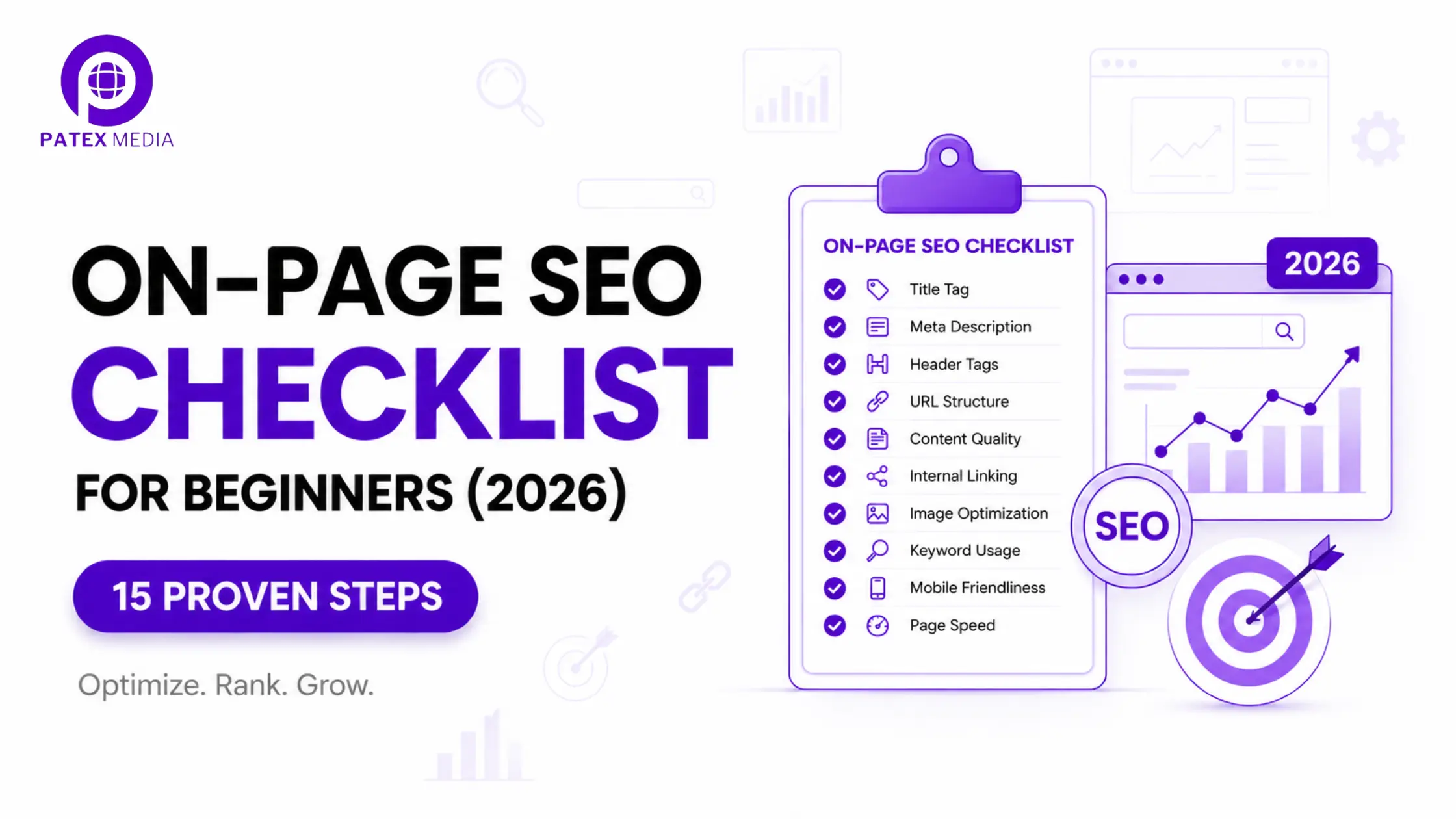
The guide is an on-page SEO checklist of 15 steps aimed at beginners to represent the best practices that are in accordance with the standards of the 2026 algorithms.
What Is On-Page SEO in 2026?
On-page SEO is the process of optimizing web pages so that they can be more visible in search engines as well as increase their relevance to the user and the artificial intelligence ranking algorithms. It is way beyond the conventional HTML optimization in 2026.
In the current on-page SEO, emphasis is made on:
- Semantic relevance (depth on topic and entity relationships)
- User intent satisfaction
- Content structure and readability
- Page experience and performance signals
- Structured, machine-readable formatting
In contrast to the previous models of SEO, the search engines currently analyze pages with the help of the AIs-based meaning models that do not only analyze the keywords but also the meaning. The knowledge of Moz brings out the fact that topical power and content completeness are now critical ranking factors.
Why On-Page Optimization Is Critical for Ranking in 2026
Organic visibility is based on on-page SEO as it is the tool that directly reflects the interpretation, categorization and ranking of your content by search engines.
The major reasons why it is imperative:
- AI-Driven Search Understanding
Modern search systems rely on semantic models that interpret meaning rather than matching exact phrases.
- User Intent Alignment
The content should be accurate in terms of informational intent, navigational intent or transactional intent.
- Improved Crawl Efficiency
Properly constituted pages are easier to be read and index by the crawlers.
- Enhanced UX Signals
Measures such as engagement, scroll depth and pattern of interaction have been indirectly added to rankings.
According to Ahrefs, pages are always ranked higher when they have good on-page optimization as opposed to those that are only dependent on backlinks.
Read More: How Long Does SEO Take to Show Results in 2026?
15-Step On-Page SEO Checklist for Beginners (2026 Edition)
- Conduct Intent-Based Keyword Research
The search volume is no longer the only important aspect of modern research of keywords. It has to do with the knowledge of clusters of user intent.
Focus on:
- Informational intent (guides, definitions)
- Commercial intent (comparisons, reviews)
- Transactional intent (purposeful queries).
Group related queries with the use of such tools as Ahrefs or semantic key-word mapping as opposed to targeting individual keywords.
- Map Primary Secondary Entities
It is now possible to have search engines with knowledge about entities (people, brands, concepts). Identify:
- Core topic entity
- Supporting entities
- Related subtopics
Example: For “on-page SEO,” entities include internal linking, metadata, search intent, and structured data.
This enhances topical power and semantic richness.
- Write SEO Titles with Contextual Relevance
Titles must be:
- Clear and descriptive
- Intent-aligned
- Devoid of keyword stuffing.
Best practice: Replacing On-Page SEO Tips SEO SEO Guide with:
On-Page SEO Checklist for Beginners (2026 Guide)
- Optimize Meta Descriptions for Click Intent
The meta descriptions do not have a direct effect on the ranking as they have a very strong influence on the CTR.
Effective meta descriptions:
- Concisely describe the value in 1–2 sentences
- Include intent-driven language
- Avoid generic phrasing
Example: On-page SEO Checklist 15 steps to a 2026 ranking system, AI search optimization, and a beginner-friendly implementation.
- Structure Content with Semantic Headings (H1–H3)
The structure of the heading is also done correctly to enhance crawling and readability.
Best practices:
- One H1 per page
- H2 for large sections
- H3 for subpoints
Headings help the search engines to comprehend the topical structure and content hierarchy.
- Optimize Content Depth and Topical Coverage
Thin content is no longer a competitive one.
High-ranking pages in 2026:
- Cover multiple subtopics
- Respond to questions of the users.
- Provide contextual depth
According to the research conducted by Search Engine Journal, detailed content is always more competitive than shallow ones in the search results list.
- Improve Readability and Content Flow
Even the most developed SEO information should be readable.
Focus on:
- Short paragraphs
- Logical progression
- Clear transitions
- Minimal jargon
AI systems take into consideration engagement signals, which depend on readability.
- Use Internal Linking Strategically
There is internal linking, which disperses authority and enhances crawl paths.
Best practices:
- Naturally, provide links to other relevant pages.
- Describe using anchor texts.
- Avoid over-optimization
Internal links also assist in determining clusters of topical links in your site.
- Optimize Images with Contextual Alt Text
Image SEO is still significant in accessibility and semantic interpretation.
Ensure:
- Descriptive alt text
- Relevance of the context (not keyword stuffing)
- Compressed file sizes for performance
Image context is one of the elements of page understanding used to construct search engines.
- Add Structured Markup (Schema Markup)
Organized information is appropriate in order to make machines better understand your content.
Common types:
- Article schema
- FAQ schema
- Breadcrumb schema
This increases the chances of being eligible in terms of rich results and a better SERP.
- Improve Page Speed and Core Web Vitals
Performance is also a factor of critical ranking.
Key metrics:
- Loading speed (LCP)
- Interactivity (INP)
- Visual stability (CLS)
Websites that are slow decrease involvement and have a disadvantageous effect on the ranking.
- Ensure Mobile-First Optimization
The mode of evaluation used by Google is mobile-first indexing.
Ensure:
- Responsive design
- Fast mobile loading
- Small screen readable typeface.
The performance that is directly influenced by mobile usability is ranking.
- Optimize URL Structure for Clarity
The URLs should be SEO friendly, and they should be:
- Short
- Descriptive
- Hierarchically structured
Example: /seo/on-page-checklist-2026
The use of unnecessary parameters or dynamic strings should be avoided.
- Strengthen Content Trust (E-E-A-T Principles)
Trust signals constitute a very important element of modern SEO:
- Experience
- Expertise
- Authoritativeness
- Trustworthiness
To improve trust:
- Cite credible sources
- Use factual data
- Maintain author transparency
According to Google search central, quality and reliability of content are the major ranking criteria.
- Continuously Update and Refresh Content
SEO is not static. Pages need to be developed with:
- Algorithm updates
- Industry trends
- User behaviour changes
Freshness signals are enhanced by updating the content and do not compromise the ranking.
The websites, such as Search Engine Land, often emphasize the fact that the updated information is always superior to the outdated pages in competitive niches.
Practical Example: On-Page SEO Optimization in Action
Consider a blog targeting local SEO tips for beginners
Before optimization:
- Weak structure
- Keyword-heavy headings
- No internal linking
- Limited depth
After applying the checklist, the following improvements were made:
- Clear intent-based structure
- Entity-rich content
- Schema markup added
- The links to related SEO guides within the company.
- Faster and mobile user experience.
Result: the visibility and possibility of engagement have increased considerably.
Conclusion
The concept of on-page SEO in 2026 is based on the aspects of semantic clarity, user content satisfaction, and content design. Those beginners who learn and apply these 15 steps will be in a good position to establish a solid ground for long-term organic exposure.
The change towards the preventative optimization based on the keyword to the AI-based contextual interpretation implies that success is now based on the ability of the page to convey the meaning, structure, and credibility.
With this checklist in place every single time– and using trusted SEO models like Moz, Ahrefs and Search Engine Journal as reference material, you will significantly improve your chances of ranking at the top of search results in 2026.
SEO success requires more than just a checklist; it needs the right execution.
If you’re searching for the best SEO company in Delhi NCR, Patex Media can help you build a custom SEO strategy focused on rankings, traffic, and long-term business growth.